Exploring the Intersection of Environmental History and the History of Technology: The Silicon Valley Archives at Stanford
We recently had the opportunity to speak with Henry Lowood, the Harold C. Hohbach Curator, and Charles Petersen, the Harold Hohbach Historian, about the vast and growing Silicon Valley Archives at Stanford. Our conversation shed light on the rich historical resources available at Stanford and their significance for researchers and scholars exploring the intersection of environmental history and the history of technology. The following Q&A is based on our in-depth discussion.
What are the Silicon Valley Archives?
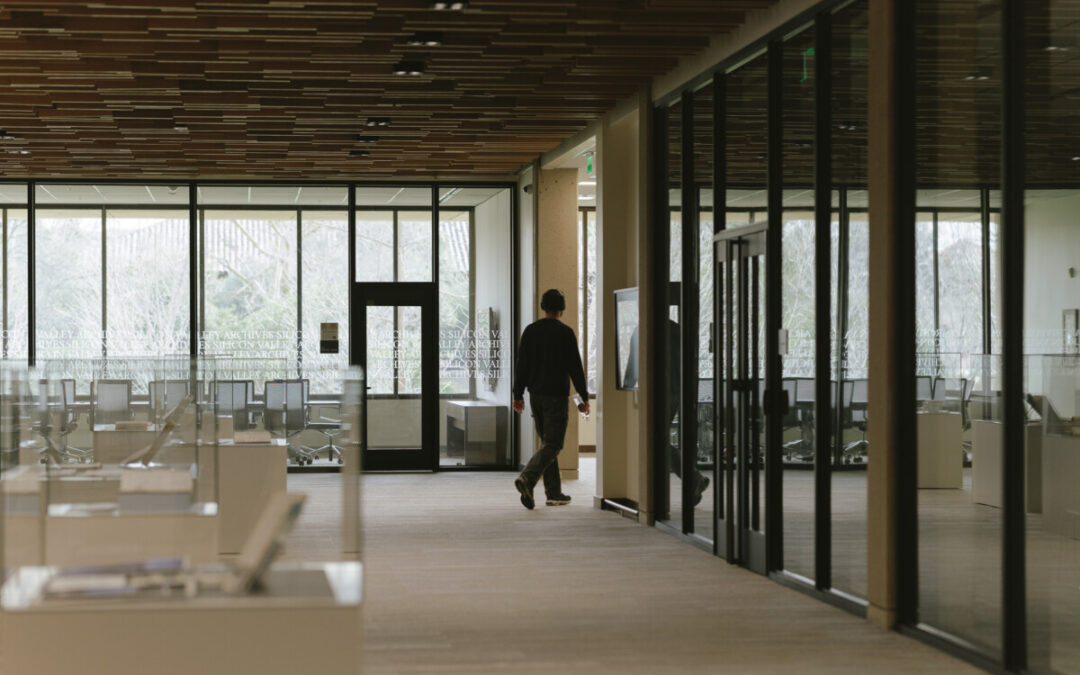
The Silicon Valley Archives—housed in Stanford Libraries’ Department of Special Collections—was established in 1985 to collect and preserve documents and records related to the history of Silicon Valley, one of the world’s most important centers for scientific and technological innovation.
The emergence of high-technology industries in the region—such as the laser, semiconductor, personal computer, video and sound recording, video game technology, cloud computing, virtual reality, and artificial intelligence—has profoundly transformed humanity and the environments in which we live. These changes have had a global reach, making Silicon Valley the focus of expansive, interdisciplinary research that seeks to understand not only the place that made these innovations possible but also their broader impact on the world. The Silicon Valley Archives exist to facilitate that research.
What kinds of resources can be found in the Silicon Valley Archives?
Initially, the archives focused on gathering faculty papers from Stanford’s engineering and business schools, given their deep involvement in the region’s technological and scientific developments—a practice that remains a priority, as Stanford continues to be central to Silicon Valley’s evolution. Over time, the collections have expanded to include the records of companies, individuals, and social movements that have shaped Silicon Valley. Some of the most prominent collections include the papers of Doug Engelbart (the inventor of the computer mouse), Fred Terman (often called the “father of Silicon Valley”), and the archives of Apple and Ampex.
How does environmental history fit into the history of Silicon Valley?
While Silicon Valley is often viewed as a hub of innovation and technology, its history is also deeply tied to environmental impact, resource extraction, and evolving conceptions of sustainability.
Many early technological advances relied on mining and chemical processing, and rapid industrial expansion left a legacy of pollution and environmental challenges. For example, we have records related to the New Almaden Mine, a mercury mine founded in 1846 as California’s first mining operation, located just 12 miles south of downtown San Jose. Although its operations ceased before Silicon Valley became the technological and scientific hub it is today, its history helps researchers contextualize the region not only as a major site of manufacturing and innovation but also as a site of exploitation and toxic waste.
Additionally, Silicon Valley has the highest concentration of Superfund sites—areas designated by the Environmental Protection Agency as contaminated by hazardous substances—in the United States. These sites are a direct consequence of the semiconductor industry’s waste disposal practices in the 1980s. The archives provide invaluable primary sources documenting these environmental issues, along with records of local movements that arose in response, including oral histories, technical reports, and unpublished professional correspondence.
How do the Silicon Valley Archives capture the global impacts of Silicon Valley?
Until the 1990s, Silicon Valley was primarily a manufacturing center, with a large workforce involved in semiconductor and microchip production. However, as production shifted overseas, the region became increasingly focused on software and digital innovation.
One particularly noteworthy collection we have recently acquired is that of the Pacific Studies Center, a Mountain View-based nonprofit founded by Lenny Siegel, a former Stanford student activist. Established in 1969, the Pacific Studies Center was devoted to exploring the environmental impacts of Silicon Valley, not only in California but across the broader Pacific region. Although the collection is still being processed, it includes reports on the environmental consequences of offshoring semiconductor production, the toxicity of electronics manufacturing, and the social dynamics of the industry’s workforce. Once released, the Pacific Studies Center collection will be an excellent resource for scholars working at the crossroads of environmental and technological history.
How did Silicon Valley engineers and thought leaders view the environment?
Beyond business and industrial history, the Silicon Valley Archives also house materials from countercultural movements that have influenced the region’s development and self-conceptualization. The ideas of intellectual leader Stewart Brand, best expressed in his Whole Earth Catalog—a publication promoting self-sufficiency, ecology, and alternative education—were highly influential to many of Silicon Valley’s leading inventors and industrialists. Fortunately, Brand donated his personal papers and the entire collection of the Whole Earth Catalog to us, where they can be accessed by researchers today. These materials provide a fascinating glimpse into the early ecological and technological visions that shaped conversations about sustainability and alternative energy in Silicon Valley.
Additionally, the archive contains the personal papers of thinkers such as John Perry Barlow, a Grateful Dead lyricist and early theorist of cyberspace. Barlow’s writings explore the ideological underpinnings of digital culture, touching on issues of environmental philosophy and technological optimism.
While it’s important to know about Silicon Valley’s leaders, how can I use the Silicon Valley Archives to tell the stories of those whose voices are often overlooked?
The histories of Silicon Valley’s successes are often dominated by its most famous leaders, but the region’s history is much richer than that. Beyond the well-known founders, CEOs, and industry pioneers, thousands of workers, environmental activists, and other contributors have shaped this hub of technological and scientific innovation. However, their stories are often left out of mainstream narratives.
Efforts like the Ken and Caretha Coleman Archive of African American Histories in Silicon Valley help address these omissions by documenting the crucial roles of African American businesspeople, engineers, and entrepreneurs, who have long been underrepresented in traditional records. Even when archival materials do not directly reflect the experiences of underrepresented groups, researchers can read archival materials “against the grain,” uncovering stories through the traces and silences within existing records that help us understand their contributions.
Building on these efforts, we are launching a new oral history initiative, tentatively called “Hidden Silicon Valley,” to document and amplify the voices of underrepresented communities in the tech industry.
How can I access the Silicon Valley Archives?
Researchers can discover more information about these collections by visiting the library’s online catalog, SearchWorks. The collection records in SearchWorks provide links to finding aids (collection listings) at the Online Archive of California, where boxes from these collections can be paged to the library’s reading room for access. Visitors should ensure that they submit requests at least five days before their visit to the reading room. While some collections are still being processed due to their vast scope, researchers can request priority access to unprocessed collections by expressing interest through the catalog records in SearchWorks. For those interested in exploring these materials, we encourage you to visit Stanford’s Special Collections or browse available resources online.
Environmental history and the history of technology are deeply intertwined. The Silicon Valley Archives stand as a testament to this relationship, preserving records that reveal how technological development and environmental change have influenced one another. For more information, please email svarchives@stanford.edu or visit their website here.
*Content written by Mariana Calvo